
Annonces
The use of GPS data in Ligue 1 teams’ training in 2026 is expected to rise by 15%, deeply changing how players are prepared physically and tactically in the pursuit of optimised performance.
Modern football is constantly evolving, and technology is a major part of it. In 2026, the growing role of GPS data in Ligue 1 teams’ training, with a 15% rise in use, is no longer a simple trend but an unavoidable reality. This technology is radically transforming how French clubs approach performance and manage their athletes. Read on to understand the deep impact of this innovation on the game.
Technological evolution at the heart of French football
The integration of cutting-edge technology into sport is no secret. Football in particular has embraced that revolution, constantly seeking to optimise every aspect of performance. GPS data has become an essential tool for Ligue 1 teams, giving them unprecedented visibility into their players’ physical capacity and movement.
Annonces
That widespread adoption is the product of several years of development and testing. What was once an experimental tool is now a standard, letting coaches and fitness trainers make informed decisions based on hard facts rather than intuition.
Precision sensors for sharper analysis
Modern GPS sensors are miniaturised and built into discreet vests worn by the players. These devices collect a multitude of data with remarkable precision, well beyond simple distance covered. They measure speed, acceleration, deceleration, changes of direction and even workload.
- Top speed: identifying sprints and speed peaks to assess players’ explosiveness.
- Distance covered: a precise measure of endurance and overall activity on the pitch.
- Accelerations and decelerations: analysing intense efforts and sudden stops, indicators of muscle fatigue.
- Workload: quantifying the overall intensity of training and matches.
In short, the technological evolution within Ligue 1, driven by GPS data, is redefining the shape of training and performance. It offers a scientific, detailed approach that was unimaginable a few decades ago, pushing the limits of what athletes can achieve.
Annonces
Optimising individual and collective performance
One of the most significant advantages of GPS data is its ability to refine training for each player and for the team as a whole. Generic training programmes are gone; extreme personalisation based on objective metrics and specific goals has taken over.
Every player has a unique profile, with his strengths and weaknesses. GPS data makes it possible to identify those precisely, giving fitness trainers the information they need to design tailored sessions aimed at improving the weak points while consolidating the strengths.
Personalised training programmes
Thanks to the data collected, coaches can adjust the volume and the intensity of the exercises. A centre-back, for example, will have a different programme from a winger. GPS data reveals the specific demands of each position, making it possible to adapt training to simulate match conditions as closely as possible.
- Adjusting intensity: increasing or reducing the difficulty of exercises according to the player’s recovery and condition.
- Position-specific work: focusing the effort on the movements and exertions typical of each athlete’s role.
- Tracking progress: assessing the effectiveness of the programmes and making adjustments in real time.
Beyond the individual, GPS data also contributes to collective optimisation. It makes it possible to analyse the interactions between players, running patterns and tactical movement, offering an overall view of the team’s dynamic. That analysis helps coaches fine-tune their strategies and improve cohesion on the pitch.
Injury prevention and workload management
Injury prevention is a major concern in professional football. GPS data plays a crucial role by providing early indicators of fatigue and overload, letting medical and technical staff intervene before an injury occurs.
Overload is one of the main risk factors for muscle injuries. By monitoring players’ efforts closely, it is possible to adjust their schedules, grant extra rest periods or change the exercises to reduce the strain on specific areas of the body.
Detecting the signs of fatigue early
Sophisticated algorithms analyse variations in a player’s usual performance. An unexplained drop in top speed, fewer accelerations or more decelerations can all be warning signs. These indicators, combined with other physiological data, make it possible to anticipate fatigue.
- Performance variability: identifying deviations from each player’s established norms.
- Effort ratios: comparing intense efforts with recovery periods to assess the physical balance.
- Micro-traumas: monitoring repeated impacts that can lead to long-term injuries.
Managing workload is a delicate balance between the demands of performance and the need to protect athletes’ physical integrity. GPS data offers the precision needed to navigate that balance, making sure players are at their best while minimising injury risk. That proactive approach is essential to the longevity of careers and to teams’ success.
Tactical and strategic impact on the game
Beyond physical performance, GPS data offers valuable perspectives on the tactical and strategic side of the game. It makes it possible to analyse players’ movement on the pitch, their positioning relative to team-mates and opponents, and the effectiveness of the patterns put in place.
Coaches can view heat maps showing each player’s most intense activity zones, or graphics illustrating running density in different parts of the pitch. That information is crucial to understanding how a strategy is unfolding in real time and identifying the adjustments needed.
Analysing movement and positioning
GPS data reveals whether players are following the tactical instructions, whether they are occupying the right areas and whether they are creating space for team-mates. It also makes it possible to study movement off the ball, often as important as movement with it.
- Heat maps: visualising the areas players favour.
- Distances between players: analysing the team’s compactness and the coordination of its movement.
- Tactical responsiveness: assessing how quickly players adapt to changing situations.
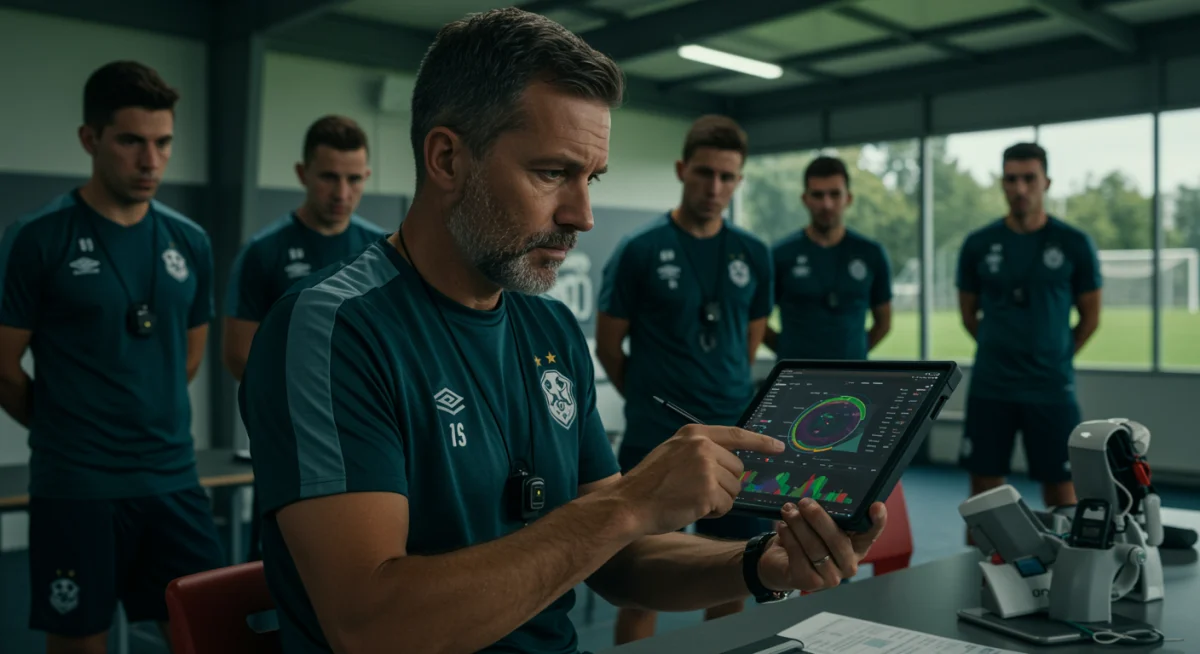
Using GPS data for tactical analysis lets coaches break the game down in granular detail. They can identify gaps in the pressing, weaknesses in the defensive recovery or attacking opportunities that went unused. This data-driven approach raises the level of tactical analysis and offers a significant competitive advantage.
Challenges and future prospects for GPS data in Ligue 1
Despite the undeniable advantages, integrating GPS data into Ligue 1 is not without challenges. The colossal quantity of data generated requires powerful analysis tools and experts able to interpret it. In addition, standardising protocols and ensuring interoperability between different systems remain significant issues.
Training the technical staff is also essential. Collecting data is not enough; you have to know how to use it effectively to make relevant decisions. Clubs have to invest in training their coaches, fitness trainers and analysts to maximise the technology’s potential.
Integrating artificial intelligence
The future of GPS data in football will inevitably involve deeper integration of artificial intelligence (AI) and machine learning. AI will be able to analyse even larger volumes of data, identify complex patterns and predict trends, going beyond human capabilities.
- Injury prediction: AI could anticipate injuries with greater accuracy by analysing thousands of parameters.
- Strategy optimisation: algorithms could suggest tactical adjustments in real time as a match develops.
- Developing young talent: AI would help identify potential and personalise development from an early age.
The prospects are vast. One can imagine systems where GPS data is combined with biometric data, video analysis and environmental information to create a complete performance ecosystem. That technological synergy promises to transform football further, making it more scientific and more spectacular.
The 15% rise in use in 2026: why?
The estimate of a 15% rise in the use of GPS data in Ligue 1 by 2026 is not accidental. It rests on several converging factors that underline the growing value of this technology to French professional football. Clubs increasingly recognise that investing in these tools translates into tangible gains on the pitch.
Ligue 1’s growing competitiveness, with ever higher financial and sporting stakes, pushes teams to look for every possible advantage. GPS data offers precisely that opportunity, allowing marginal gains that can make the difference between winning and losing.
The key factors behind the increase
Several elements explain that growth. Continuous improvement in GPS technology, making sensors more reliable, lighter and more precise, plays a major role. Costs, while still significant, have become more accessible to a greater number of clubs.
- Better technology: higher-performing sensors and more intuitive analysis software.
- Awareness of the benefits: clubs have seen the positive impact on performance and the reduction in injuries.
- Competitive pressure: the need to keep pace with teams already using these technologies.
- Training and expertise: a better understanding and use of the data by technical staff.
In conclusion, the 15% rise in the use of GPS data in Ligue 1 by 2026 reflects an irreversible trend towards a more scientific, data-driven game. It is a strategic step that lets clubs maximise their players’ potential, minimise the risks and, ultimately, reach sporting excellence.
| Key point | Brief description |
|---|---|
| Performance optimisation | GPS data personalises training for each player, improving position-specific endurance, speed and strength. |
| Injury prevention | Monitoring workload and detecting early signs of fatigue to reduce the risk of muscle injuries. |
| Tactical analysis | Assessing movement, positioning and the effectiveness of game plans for precise adjustments. |
| Rise in use | Factors such as better technology and greater competitiveness explain the 15% rise by 2026. |
Frequently asked questions about GPS data in Ligue 1
GPS data provides precise information on players’ physical performance, including speed, distance, acceleration and workload. That makes it possible to personalise training, optimise tactical strategies and manage fatigue better to prevent injuries.
By monitoring workload and detecting variations in performance, GPS systems can identify signs of fatigue or overload. That lets technical staff adjust training programmes and grant rest, reducing the risk of muscle injuries before they occur.
No, the use of GPS data is adapted to the specifics of each position. A centre-back does not have the same physical demands as a forward or a midfielder. Training programmes are personalised to reflect those differences and optimise individual performance.
The challenges include managing and analysing massive volumes of data, the need to train technical staff to interpret that information, and standardising the equipment and protocols to ensure effective interoperability between systems and clubs.
AI could revolutionise GPS data analysis by identifying complex patterns, predicting injury risk with greater accuracy and suggesting tactical adjustments in real time. It will allow even deeper optimisation of performance and game strategy.
Conclusion
Integrating GPS data into Ligue 1 teams’ training represents a major advance for French football. The 15% rise in its use by 2026 speaks to its invaluable contribution to optimising individual and collective performance, preventing injuries and refining tactical strategies. While challenges remain, notably around data management and training, the future promises an even deeper synergy with technologies such as artificial intelligence, opening the way to a new era of professionalism and sporting excellence on Ligue 1 pitches.