
Annonces
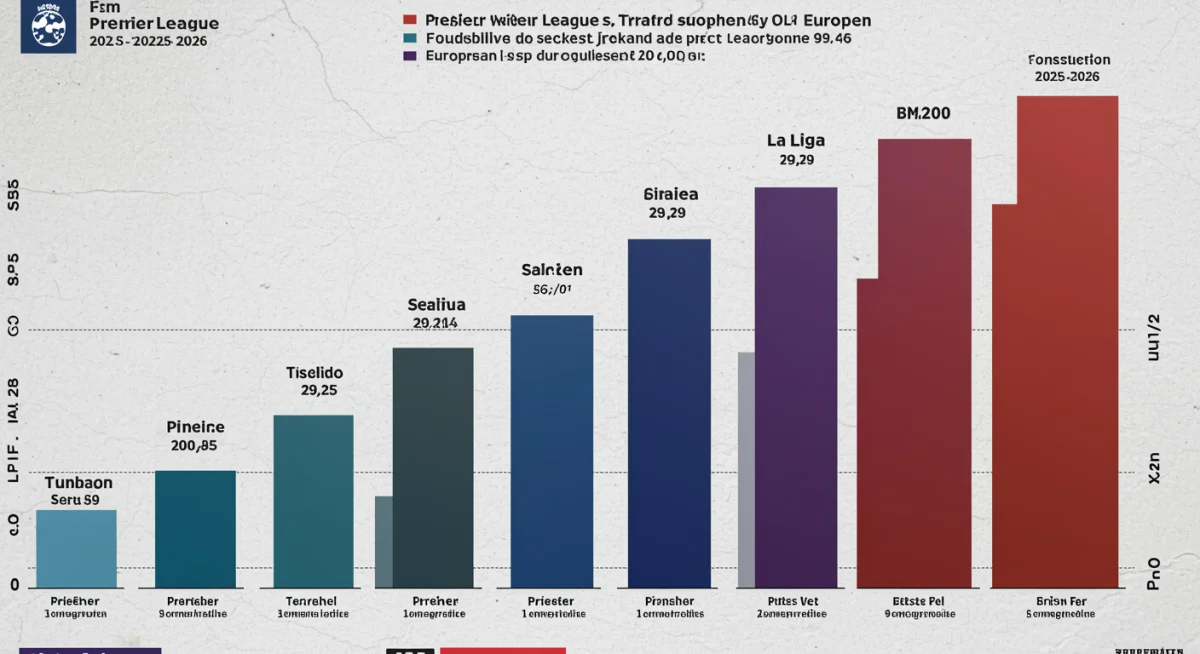
A comparison of transfer budgets across Europe’s big 5 leagues for the 2025-2026 season reveals complex financial dynamics driven by television rights, commercial revenue and regulation, determining the future competitiveness of clubs in the player market.
The 2025-2026 season is shaping up to be a major turning point for European football, and the comparison of transfer budgets across Europe’s big 5 leagues for the 2025-2026 season will be scrutinised more closely than ever. As clubs prepare to face new economic and sporting challenges, their capacity to invest in the player market remains a key indicator of their ambitions. Who will be the dominant forces, and which leagues will pull ahead of the rest in this race for talent?
Annonces
The Factors Driving Transfer Budgets
The transfer budgets of European clubs are not determined by a single factor, but rather by a complex set of interdependent elements. Understanding these levers is essential in order to anticipate market movements and team strategies. The overall financial health of each league, its ability to generate revenue and the economic strength of its member clubs all play a leading role.
Broadcasting rights account for the lion’s share of revenue for most leagues and clubs. Lucrative contracts with domestic and international broadcasters give teams a solid financial base for their operations, including transfers. However, negotiating these rights is an ongoing process, and any fluctuation can have a direct impact on the funds available.
Annonces
The Impact of TV Rights and Commercial Revenue
The English Premier League, for example, has historically enjoyed the highest television revenue, giving it a significant advantage in purchasing power. The other leagues are trying to close the gap, but fragmented markets and increased competition make that goal difficult. Commercial revenue, from sponsorship, merchandising sales and ticketing receipts, is also crucial.
- Domestic and international TV rights: The main source of revenue for most clubs, determining their capacity to invest.
- Sponsorship deals: Partnerships with major brands bring in substantial funds, often earmarked for squad improvement.
- Ticketing and hospitality revenue: Stadium attendance and VIP packages contribute significantly, especially for the biggest clubs.
- Merchandising sales: A club’s popularity translates into sales of branded products, generating additional revenue.
In short, the robustness of transfer budgets is directly linked to the ability of leagues and clubs to diversify and maximise their revenue streams. The best-run clubs and the most commercially attractive leagues are the ones that can afford the largest investments in the transfer market, thereby shaping the competitiveness and prestige of their respective competitions.
The Premier League: Still Leading the Race?
The English Premier League has long been the financial heavyweight of world football, and for the 2025-2026 season it is highly likely to retain its position as leader in transfer spending. The constant inflow of capital, notably through television rights and international investors, has created an environment in which clubs can spend colossal sums to attract the world’s best talent. That trend shows no sign of slowing, even in the face of global economic challenges.
English clubs enjoy unprecedented media exposure, which attracts major sponsors and increases their market value. This financial power translates into an ability to offer competitive wages and high transfer fees, making the Premier League extremely attractive to players and their agents. Investment in infrastructure, academies and cutting-edge technology further reinforces their dominant position.
The Investment Strategies of English Clubs
Although their financial power is undeniable, investment strategies vary from club to club. Some giants such as Manchester City or Chelsea continue to take an aggressive approach in the market, seeking to sign established stars. Others, such as Arsenal or Liverpool, focus more on developing young talent and on targeted acquisitions to strengthen specific positions. This diversity allows the league to maintain a high level of competitiveness.
Another crucial aspect is the management of player sales. English clubs are often able to sell their players at high prices, which allows them to reinvest those funds in new acquisitions, creating a virtuous cycle. The ability to generate capital gains on transfers has become an essential skill for sporting departments.
In summary, the Premier League should retain its status as the biggest-spending league in 2025-2026, thanks to its massive revenues and well-honed investment strategies. This will continue to attract the best players and guarantee a high-quality spectacle, but it also raises questions about long-term sustainability and competitive fairness relative to the other European leagues.
La Liga and Serie A: Between Financial Discipline and Ambition
Spain’s La Liga and Italy’s Serie A, two of European football’s historic competitions, find themselves in a delicate position, navigating between the need to maintain strict financial discipline and the ambition to rival the economic power of the Premier League. The 2025-2026 season will be an important barometer for assessing their ability to reconcile these two objectives, particularly where their transfer budgets are concerned.
In Spain, the financial fair play rules imposed by La Liga are among the strictest in Europe, considerably limiting clubs’ spending capacity. Giants such as FC Barcelona and Real Madrid have had to show ingenuity, juggling major player sales, economic “levers” and the search for loans to finance their acquisitions. This constraint, while beneficial for long-term stability, sometimes hampers their competitiveness in the transfer market.
Serie A’s Financial Challenges
Serie A, for its part, has been engaged in a financial recovery process for several years. Many Italian clubs have accumulated substantial debts, and the COVID-19 pandemic only accentuated those difficulties. Owners, often foreign, are seeking to clean up the accounts while trying to bring their teams back to the summit of European football. This translates into a more measured approach in the transfer market, favouring loans with purchase options, swap deals and young talent.
- La Liga’s financial fair play: Strict rules that limit Spanish clubs’ spending, forcing rigorous management.
- Economic recovery in Serie A: Italian clubs are focused on reducing debt and financial viability, which affects transfer budgets.
- Creative recruitment strategies: Increased use of loans, player swaps and young prospects to work around the constraints.
- Dependence on player sales: Clubs are often forced to sell their best players in order to fund new signings.
In conclusion, La Liga and Serie A will have to continue showing caution and innovation in order to optimise their transfer budgets in 2025-2026. Despite the constraints, these leagues still produce high-quality matches and exceptional talent, proving that wealth is not everything – though it remains a decisive factor in the race for European trophies.
The Bundesliga: Stability and Youth Development
Germany’s Bundesliga stands out for an economic model often cited as a benchmark for its stability and sound management. For the 2025-2026 season, this league should continue to prioritise the development of young talent and a balanced approach to the transfer market, rather than excessive spending. This philosophy, rooted in German football culture, has allowed clubs to remain competitive while maintaining a solid financial base.
Bayern Munich, the Bundesliga’s driving force, has the greatest purchasing power, yet even this club often prefers to sign high-potential players or those out of contract rather than entering wild bidding wars. Other clubs, such as Borussia Dortmund, are renowned for their ability to identify, develop and sell on young talent at high prices, which in turn feeds their own transfer budgets and keeps them in the race.
The 50+1 Rule and Its Influence
The Bundesliga’s “50+1” rule is a unique factor that directly influences transfer budgets. The rule stipulates that club members must hold the majority of voting rights, thereby preventing external investors from taking full control of a team. This encourages more prudent management focused on the club’s long-term interests, rather than on quick financial gains or reckless spending on spectacular transfers.
German clubs invest heavily in their academies, regularly producing world-class players. This strategy reduces dependence on costly transfers and ensures a steady flow of talent. For 2025-2026, the Bundesliga can be expected to continue backing this approach, making targeted signings to strengthen specific areas without deviating from its philosophy of sustainable development.
In conclusion, the Bundesliga, with its rigorous management and emphasis on youth development, will show more modest transfer budgets than the Premier League, but no less effective ones. Its ability to turn young prodigies into global stars allows it to remain an attractive and competitive league, proving that there are routes to success other than raw financial power.
Ligue 1: The Challenge of Keeping Its Talent
France’s Ligue 1, often nicknamed the “league of talent”, faces a persistent challenge: retaining its best players against the financial pull of the other major European leagues. For the 2025-2026 season, the comparison of transfer budgets across Europe’s big 5 leagues will highlight this structural difficulty, where French clubs often have to sell their gems to balance the books and fund new signings.
Paris Saint-Germain (PSG) is a notable exception, with transfer budgets that rival the biggest clubs in Europe, thanks to investment from Qatar Sports Investments. However, the majority of other Ligue 1 clubs operate with far more limited means, which forces them into a develop-and-sell strategy. They excel at identifying and training young players who, once established, are often sold at high prices.
Balancing Development and Sales
This strategy, while effective at generating revenue, creates a cycle in which clubs struggle to build stable, experienced teams over the long term. The departure of key players regularly weakens squads, making progress in European competition and the consolidation of a team identity difficult. For 2025-2026, Ligue 1 will look for a better balance, perhaps by increasing its television revenue or by attracting new investors to its most promising clubs.
- Dependence on PSG: PSG dominates the league financially, distorting any comparison with the other clubs.
- Develop-and-sell strategy: French clubs excel at developing young players, but often sell them to wealthier leagues.
- TV rights challenges: Broadcasting rights negotiations are crucial to increasing the league’s overall budgets.
- European competitiveness: The difficulty of retaining talent affects the performance of French clubs on the continental stage.
In conclusion, Ligue 1 will remain a talent factory in 2025-2026, but its overall transfer budgets, PSG aside, will probably remain lower than those of its English, Spanish, Italian and German counterparts. The challenge will be to turn this development capacity into a lasting strength, allowing clubs to keep their best players and compete more effectively on the European stage.
Financial Regulation and Fair Play: The New Rules of the Game
Financial regulations and UEFA’s Financial Fair Play (FFP) have become major factors in determining the transfer budgets of European clubs. For the 2025-2026 season, UEFA has introduced significant reforms aimed at promoting greater financial stability and better competitive fairness. These new rules, focused on solvency and sustainability, will have a direct impact on how clubs are able to spend in the transfer market.
The new regulations replace the old FFP with a stricter system of squad cost control. Clubs must now limit their spending on wages, transfers and agent commissions to a defined percentage of their revenue. That percentage will be progressively reduced over the coming seasons, forcing clubs into even more rigorous management of their finances. The aim is to prevent clubs from spending beyond their means and taking on excessive debt.
Impact on Club Transfer Strategies
This reform will have several consequences for transfer budgets in 2025-2026. Clubs will have to be smarter and more strategic in their signings. The value of home-grown players and the ability to generate revenue through sales will become even more important. Loans with purchase options and player swaps could become more common transfer mechanisms, allowing clubs to work around immediate spending limits.
Clubs will also need to pay particular attention to the wage bill, since it represents a significant share of squad costs. Long-term contracts, bonuses and performance clauses will be examined closely. The goal is to create an ecosystem in which sporting success is linked more to sustainable management than to the simple injection of unlimited capital.
In conclusion, UEFA’s financial regulations for 2025-2026 will redefine the rules of the game for transfer budgets. Clubs will have to display greater financial discipline and tactical ingenuity to stay competitive. This could level the playing field slightly between leagues, but the wealthiest clubs will still hold an advantage thanks to their ability to generate larger revenues, giving them more room for manoeuvre within the imposed limits.
Forecasts and Trends for the 2025-2026 Season
Anticipating transfer budget trends for the 2025-2026 season is a complex exercise, but several indicators allow a general picture to be sketched. The comparison of transfer budgets across Europe’s big 5 leagues for the 2025-2026 season will be marked by a consolidation of the existing hierarchy, but also by adaptation to new economic and regulatory realities. The Premier League should retain its leadership, but the other leagues will look for innovative ways to close the gap.
An increase in the importance of data analytics and advanced scouting can be expected as clubs seek to identify undervalued talent. Clubs will aim to optimise every euro spent, focusing on players who fit their system of play and their culture perfectly. The agent market will continue to be an influential factor, but clubs may look to reduce commissions in order to maximise their direct investment in players.
Emerging Markets and the Influence of International Competitions
The rise of leagues outside Europe, such as the Saudi Pro League, could continue to influence the market, offering staggering wages and creating unexpected competition for talent. However, the appeal of the major European leagues and the prospect of playing in the biggest competitions (the Champions League, the Club World Cup) should maintain their pulling power for most top-level players.
The expanded Club World Cup, scheduled for 2025, could also have an impact on budgets. The additional revenue generated by the competition could be reinvested by the participating clubs, giving them a temporary advantage in the transfer market. The emphasis will be on building deep, versatile squads capable of coping with the demands of an ever more congested fixture calendar.
In conclusion, 2025-2026 will be a year of transition and adjustment for transfer budgets. Financial caution and strategy will become the watchwords, but the pursuit of the best players will remain a priority. The leagues that manage to combine sound management with an ambitious sporting vision will be the ones to emerge stronger from this period, shaping the future of European football for years to come.
| Key Aspect | Brief Description |
|---|---|
| Premier League | Financial leader, high budgets driven by TV rights and investment. |
| La Liga & Serie A | Financial discipline, creative transfer strategies and reliance on sales. |
| Bundesliga | Stability, youth development and sound management (the 50+1 rule). |
| Ligue 1 | Talent factory, retention challenge, reliance on resales (PSG aside). |
Frequently Asked Questions About Transfer Budgets
TV rights are the main source of revenue for leagues and clubs. Lucrative contracts give teams larger funds for buying players, paying wages and building infrastructure, strengthening their purchasing power in the transfer market.
The new UEFA regulations cap wage and transfer spending at a percentage of revenue. This forces clubs into more prudent management, favouring player sales and smart recruitment strategies in order to stay within the financial limits.
The Premier League benefits from massive global TV rights, strong commercial appeal and significant foreign investment. These factors give it unmatched financial power, allowing it to sign the best players at high prices.
These leagues focus on developing young talent and selling it on. The Bundesliga relies on stability and academy development, while Ligue 1, PSG aside, produces gems that it sells to wealthier clubs to fund its operations and new signings.
Yes, potentially. The additional revenue generated by the competition could be reinvested by the participating clubs. That could give them a temporary advantage in the transfer market, allowing them to strengthen their squads for a more congested calendar.
Conclusion
The comparison of transfer budgets across Europe’s big 5 leagues for the 2025-2026 season reveals a football landscape in constant evolution, shaped by economic dynamics, financial regulation and distinct club strategies. While the Premier League should retain its financial supremacy, the other leagues are adapting with ingenuity, relying on youth development, prudent management or strategic signings. The future of European football will depend on clubs’ ability to navigate this complex environment, where the balance between sporting ambition and economic viability will be more than ever the key to success on and off the pitch.